Indications
For the treatment of infections caused by microorganisms susceptible to the preparation.
ENT infections (sinusitis, otitis, etc.)
Upper and lower respiratory tract infections (bronchitis, pneumonia)
Skin and soft tissue infections
Genitourinary tract infections
Eradication of H. pylori
Endocarditis prophylaxis
Prevention of surgical infections
Bone and joint infections
Contraindications
Contraindicated in patients with a history of hypersensitivity to beta-lactam antibiotics, such as penicillins and cephalosporins.
Dosage should be monitored in patients with renal impairment.
Special warnings and precautions for use
Before initiating treatment with amoxicillin, any previous hypersensitivity reactions to penicillins, cephalosporins, or other allergens should be carefully investigated. Serious and sometimes fatal hypersensitivity reactions (including anaphylactoid reactions and severe cutaneous adverse reactions) have been reported in patients receiving penicillin therapy. These reactions are more likely to occur in individuals with a history of hypersensitivity to penicillin.
The occurrence of severe diarrhea characteristic of pseudomembranous colitis during the use of amoxicillin may require special therapeutic measures. In such cases, treatment with amoxicillin should be discontinued.
Dosage should be monitored in patients with renal impairment. Crystalluria has been observed very rarely, mainly during parenteral therapy, in patients with reduced urine output.
Dosage should also be monitored when used concomitantly with anticoagulants such as warfarin. Patients taking methotrexate should consult their physician before using amoxicillin.
Interactions with other medicinal products
Concomitant use with probenecid should be carried out under medical supervision. Probenecid reduces the renal tubular secretion of amoxicillin, thereby prolonging its elimination half-life.
The concomitant use of allopurinol during treatment with amoxicillin may increase the likelihood of allergic skin reactions.
In patients receiving mycophenolate mofetil, initiation of oral amoxicillin has been reported to reduce the concentration of the active metabolite, mycophenolic acid, by approximately 50%.
Rare cases of an increase in the International Normalized Ratio (INR) have been reported in patients treated with acenocoumarol or warfarin who were prescribed a course of amoxicillin.
Medicinal products with a bacteriostatic effect (including tetracycline antibiotics, macrolides, and chloramphenicol) may antagonize the bactericidal effect of amoxicillin. Concomitant administration with aminoglycosides may produce a synergistic effect. Oral contraceptives may have reduced efficacy when taken together with amoxicillin.
Use during pregnancy and lactation
Amoxicillin may be used during pregnancy only when clearly indicated. Small amounts of amoxicillin are excreted into breast milk, which may cause sensitization in the infant. It should not be used during breastfeeding.
Effects on the ability to drive and operate machinery
The preparation does not affect the patient's psychophysical condition. There are no reports indicating impairment of the ability to drive vehicles or operate machinery.
Dosage and administration
The dosage is determined individually, taking into account the patient's age, renal function, the susceptibility of the causative microorganism to the preparation, and the course of the disease. The preparation may be administered with or without food.
Dosage form
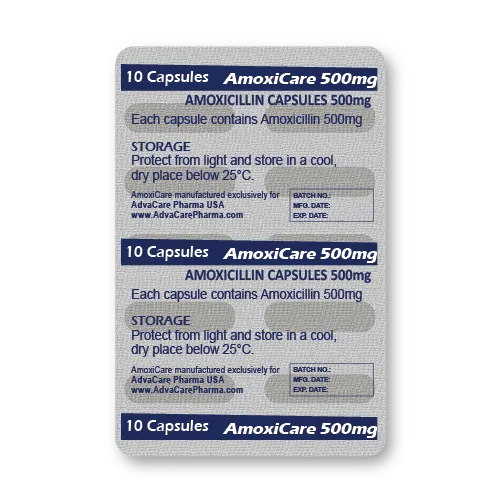
10 capsules in a blister.
10 blisters, together with the package leaflet, are packed in a cardboard box.
Storage conditions
Store at a temperature not exceeding 25°C, protected from light and out of the reach of children.
Shelf life
3 years.
Do not use after the expiry date.
Dispensing conditions
Prescription only.



Fill out the form to apply.